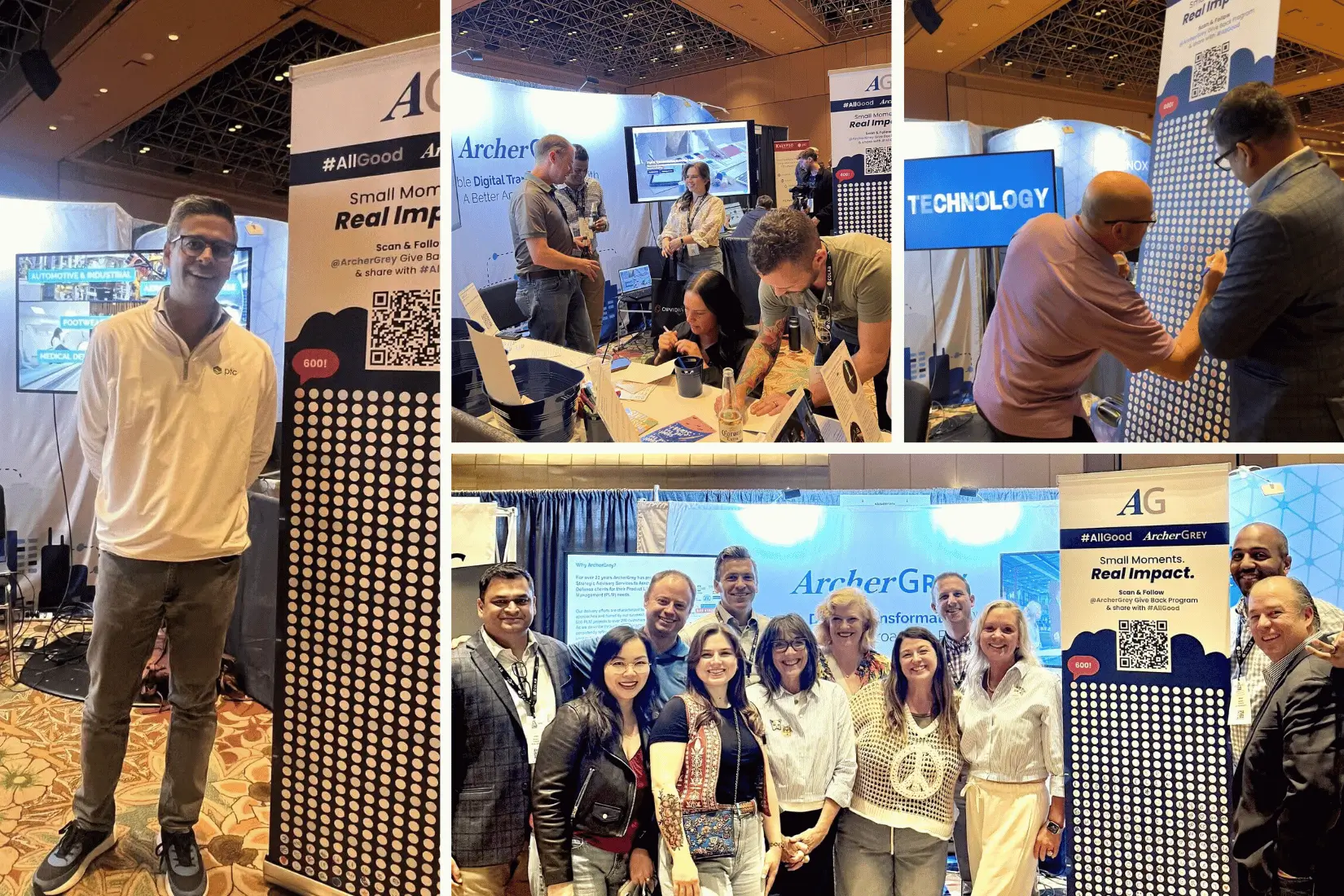
PTC/USER Global Summit 2026 wrapped up in Las Vegas after several packed days of PLM conversations, customer stories, partner sessions, and hallway discussions.
For ArcherGrey, the summit was a chance to reconnect with customers, hear what engineering and product teams are prioritizing, and get a clearer view of where the market is heading. Across sessions, booth conversations, and informal discussions, a few themes stood out.
Some of these are already familiar. Others are becoming much more urgent. Together, they point to a PLM landscape that is shifting from system implementation to measurable business impact.
The most useful summit takeaways were not necessarily the biggest announcements. They were the recurring themes in how companies are thinking about adoption, AI, integration, and measurable PLM value.
Theme 1: OCM is no longer optional
One of the clearest messages from the summit: organizational change management is no longer a “nice to have” layer around PLM.
In the panel session, Going Live or Dead on Arrival: How Properly Focused OCM Makes — or Breaks — PLM ROI, the discussion focused on a familiar challenge. PLM programs can be technically sound and still struggle if teams are not prepared, aligned, and supported through the change.
That point came up repeatedly in customer conversations. Teams are investing in PLM not just to launch a system, but to change how work gets done across functions. That means adoption has to be planned for, funded, measured, and reinforced.
One panelist also raised a related point that resonated with the room: aligning the PLM program with other ongoing strategic initiatives across the business. When PLM is positioned alongside the company’s broader transformation priorities rather than as a standalone IT project, it earns the strategic visibility, executive sponsorship, and budget it needs to succeed.
The takeaway is simple: adoption work cannot wait until the end of the project plan. It has to be built into the strategy from the beginning, and tied to the initiatives leadership already cares about.
Theme 2: AI agents are moving from theory to planning
Last year, AI in PLM was mostly a forward-looking conversation. This year, the discussion felt much more practical.
Customers are no longer asking whether AI will matter. They are asking where it can create value, what data it needs, how it should be governed, and what risks need to be addressed before it becomes part of daily work.
The most credible conversations were not about replacing engineers or automating entire processes overnight. They were about using AI agents to connect PLM, CAD, ERP, and other enterprise data sources in ways that help people find information faster, reduce repetitive work, and make better decisions.
The important shift is that AI depends heavily on the quality of the data and processes underneath it. If product data is incomplete, disconnected, or poorly governed, AI will only amplify those issues.
For many organizations, the path to AI value starts with the work they already know they need to do: clean up data, strengthen governance, connect systems, and clarify ownership.
Theme 3: Integration is the digital thread story now
Digital thread has been discussed for years, but at this summit the conversation felt more grounded.
Customers are still talking about end-to-end visibility, traceability, and lifecycle continuity. But the focus is increasingly on the practical integration work required to make that possible.
As more companies move into SaaS-deployed Windchill environments, the old approach of heavy on-premise integration is changing. The question is no longer just, “Can we connect these systems?” It is, “How do we connect them in a way that is scalable, maintainable, and aligned with where our architecture is going?”
That came through in conversations around Windchill, CAD, ERP, downstream systems, and legacy platforms. The digital thread is only useful when data can move reliably across the systems that teams actually use.
In other words, integration is not a side project. It is the foundation that makes the digital thread real.
Small moments. Real impact.
The biggest summit moments are not always the ones on stage.
Beyond the sessions and strategy conversations, one of the most meaningful parts of the week happened at Booth #54. ArcherGrey hosted the #AllGood Give Back card station, inviting attendees to write handwritten notes that were shared through a partner charity. By the end of the show, the board was full and we exceeded our goal of 600 cards!
A special thank-you to everyone who stopped by, joined a conversation, wrote a card, or shared what they are working through in their PLM journey.
What it means for PLM leaders
The biggest takeaway from PTC/USER Global Summit 2026 is that PLM maturity is becoming less about the platform alone and more about what organizations are able to achieve with it.
The companies making progress are not only implementing tools. They are thinking carefully about adoption, data quality, system integration, governance, and measurable business outcomes.
For leaders evaluating their next move, the questions are becoming clearer:
- How do we make change stick?
- How do we prepare our data and processes for AI?
- How do we connect systems in a way that supports the digital thread?
- And how do we turn PLM investment into real operational impact?
Those are the conversations we expect to continue well beyond the summit.
If these themes hit close to home
If OCM, AI readiness, integration, or PLM ROI are active priorities for your organization, ArcherGrey can help you think through the next step.