The layer of your organization most likely to determine whether a transformation succeeds is also the layer least likely to be prepared for it.
Executives get the business case, the steering committee, and the vision deck. End users get training, job aids, and a hypercare desk. Mid-level managers… get a communications cascade and a request to be supportive.
That gap has a cost, but closing it takes only about a day of the right kind of work. Here is what the gap actually is and what the day looks like.
Steady-state management and transitional leadership are different skills
Most managers are good at steady-state management. They know their process, their people, and their numbers. They can run a stable operation well, and they were promoted because they demonstrated exactly that.
Leading a team through transformation asks for something else. It means telling people who are good at their jobs that the way they are good at their jobs is changing. It means holding a standard while performance temporarily dips. It means absorbing frustration from below and pressure from above at the same time, for months, without a settled process to fall back on.
Almost nobody is trained for this, and very few people learn it by accident. So, managers default to the skill they have. They protect their team’s output, and in the short run, protecting output means protecting the old way of working, the antithesis of change.
Some workarounds don’t go away
Mid-level managers carry the largest share of the disruption, and they hold a specific power that shows up in every failed adoption post-mortem. They decide what their team can get away with.
A workaround does not survive because somebody clever invented it. It survives because a manager tolerated it. When a supervisor lets the old spreadsheet keep running alongside the new system just until things settle down, the parallel process is now sanctioned. Six months later, the organization is paying for a platform, operating on the workaround, and the adoption metrics say what they say.
This is the layer where intent becomes behavior. Everything above it is planning, strategy, and aspiration. This is where those ideas are either reinforced through daily actions or quietly replaced by old habits.
More importantly, this is the layer where adoption is created. Adoption is not something that happens to a team. It is something managers shape every day through hundreds of small interactions. Every conversation either reinforces the new way of working or quietly validates the old one.
Generic change training does not close this gap
Off-the-shelf change leadership content fails here because the difficulty is never generic. It is this Tuesday morning, this person, this conversation, this deadline.
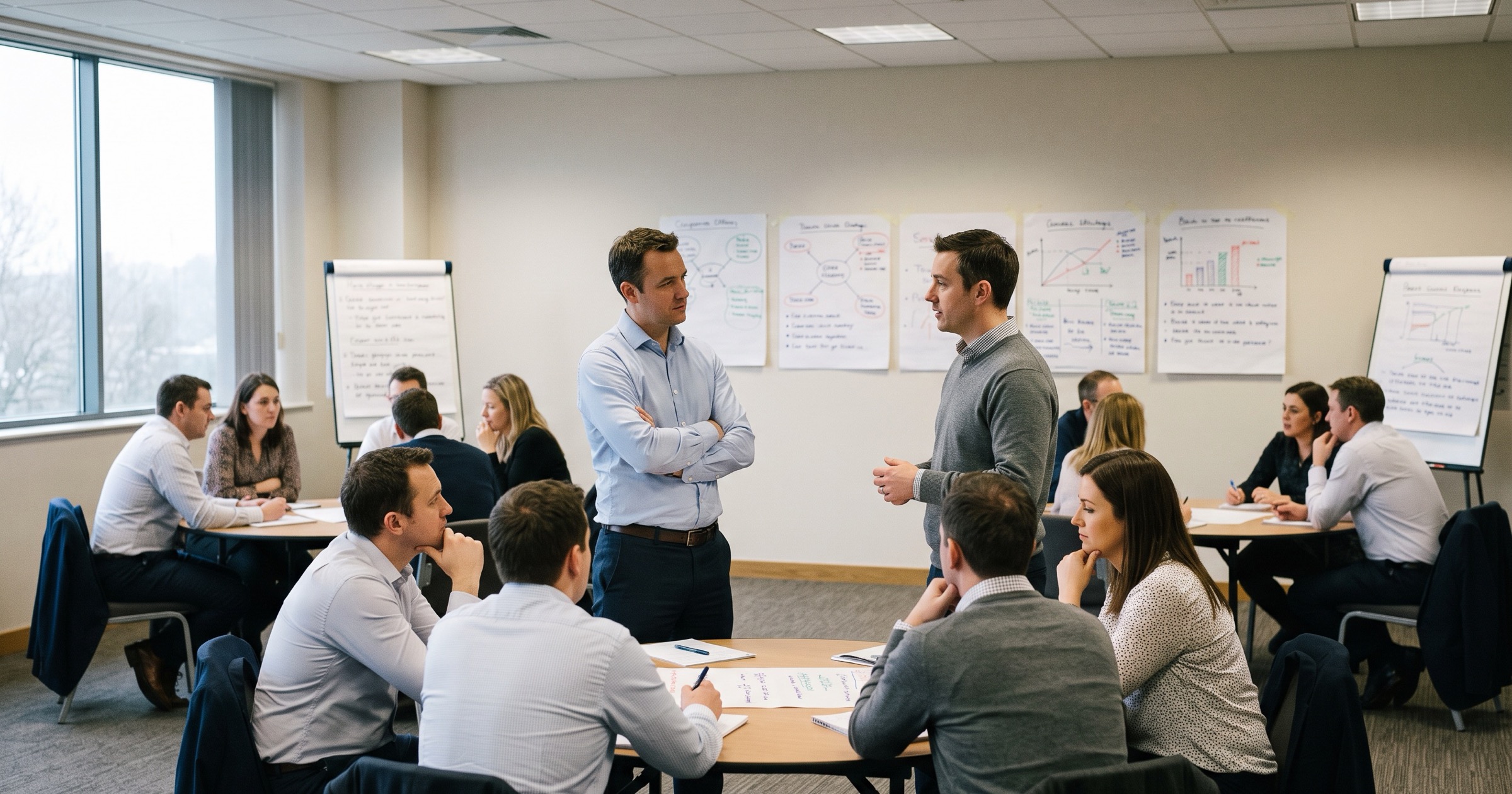
The Adoption Leader Activation LabSM reflects how we continue to evolve our adoption leadership offerings. The objective is not simply to teach managers about change. The objective is to help them become tactical Adoption Leaders.
That distinction matters. Most managers see their role as communicating change that has already been decided. Adoption Leaders understand that they are responsible for creating adoption within the teams they lead.
Every manager is already shaping adoption. The only question is whether they are doing it deliberately (well) or accidentally.
Throughout the Lab, managers work through real scenarios drawn from their own environment. They identify the stakeholders they will need to influence, the resistance they are likely to encounter, and the actions required to drive adoption within their teams for the specific changes coming. They leave not with a playbook someone else created, but with an adoption roadmap they built themselves.
The design is intentional. Organizations do not achieve adoption because managers communicate a message. They achieve adoption because managers consistently reinforce new behaviors through hundreds of small interactions over time. A manager who helped build the plan understands those moments, anticipates them, and adjusts when reality shifts. That is the version that survives contact with reality.
Rehearse the conversation with the high performer
The most valuable hour of the session is usually the role play, and the popular favorite is almost always the same scenario.
How do you tell your top performer, the person everyone in the department watches, that they are still running the old spreadsheet and are therefore setting the wrong standard for the entire team? That is a genuinely hard conversation. The employee is not underperforming. They are excellent, and their excellence is the problem, because it makes the old process look like the safe choice.
A manager who has not thought that conversation through in advance will postpone it indefinitely, and every week of postponement adds weight to the workaround. Talking it through in a room with peers and getting the words wrong a few times where it costs nothing, is what makes the real conversation happen at all.
Close with a commitment said out loud
The session ends where most change communications stop short. Not with a check that everyone understands the timeline, but with an explicit ask: what will you do, in your area, with your people, to move adoption, and will you say yes to it in front of your peers.
Awareness has never been the constraint in transformation. Willingness has. Naming a specific behavior and getting an audible yes changes what happens in the weeks afterward in a way no cascade email replicates.
Key takeaways
- Fund the manager layer as its own workstream. If your change budget has an executive line and an end-user line and nothing between them, the middle of your organization is being asked to lead a transformation on goodwill alone.
- Treat managers as adoption owners, not communication channels. Transformations succeed or fail in the daily decisions managers make about what behaviors they reinforce, tolerate, and reward.
- Do not assume transitional leadership is already in the room. Steady-state competence is what got these people promoted, and it is a different skill from leading through disruption. Treat the gap as a natural training need rather than a motivation problem.
- Build the session on their scenarios. Change leadership content that could apply to any company will be received as content that applies to no one. Use the actual resistors, roles at play, and deadlines your managers are facing next quarter.
- Have managers write their own roadmap. A plan a manager wrote gets adapted when circumstances change. A plan a manager received gets abandoned.