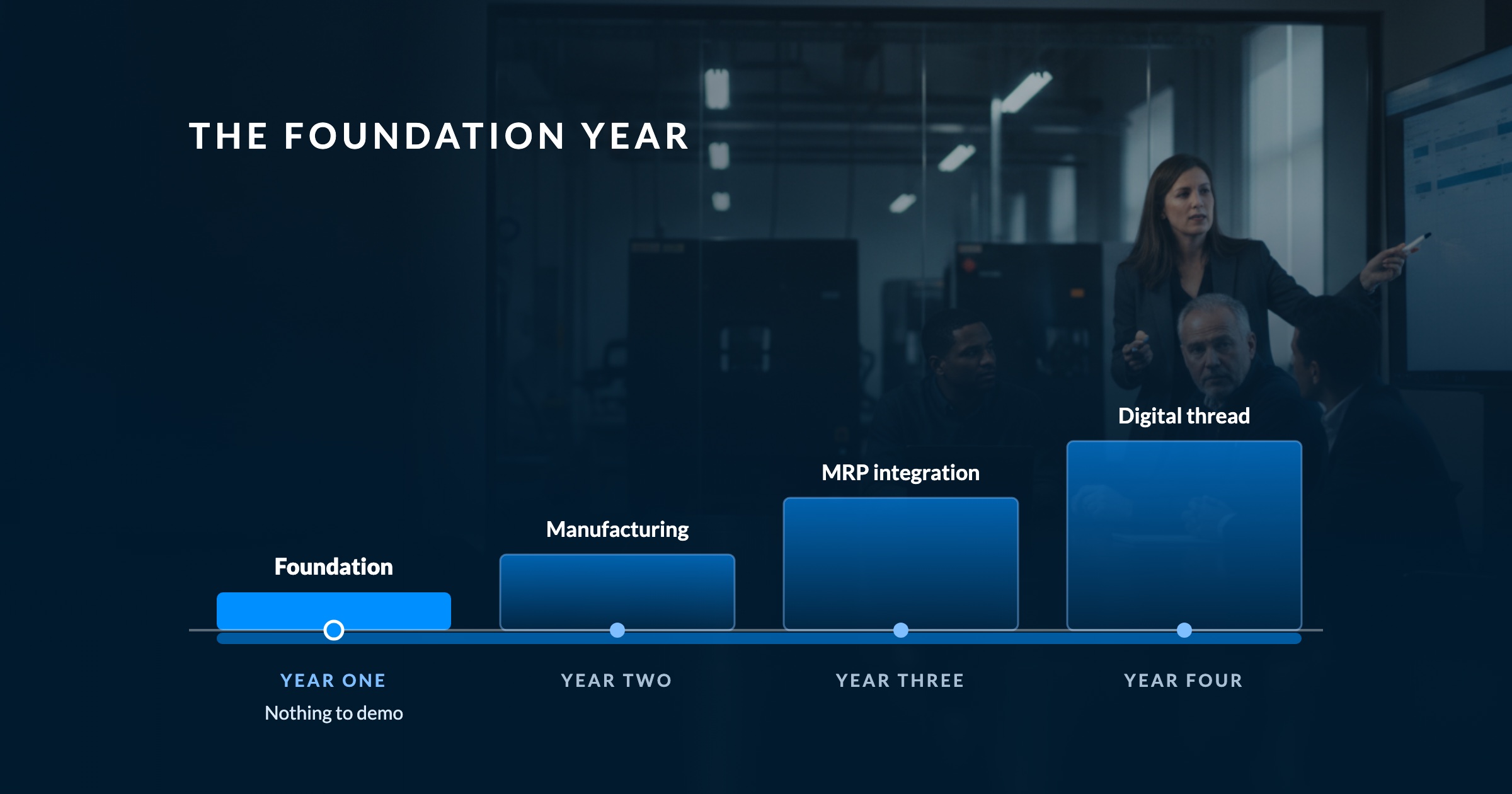
Multi-year transformations have a marketing problem: the most important year is the least impressive one. The first year rarely contains the capabilities executives are excited about. It contains the work those capabilities depend on.
Picture a manufacturer at the start of a serious digital thread initiative. Decades of legacy 2D drawings, a PLM platform used well below its potential, and a genuine mandate to become model-centric and part-centric. Leadership is bought in. Funding is approved, though in many regulated environments it can only be committed a year at a time. Everyone is ready to go.
Then the roadmap conversations start, and the client turns into a kid in a candy store. Downstream manufacturing capabilities. MRP integration. Advanced process planning. Every shiny capability the platform vendor has ever demoed suddenly belongs in scope, preferably this quarter.
Here is the analogy we keep coming back to: if you have a flat plot of land, the one thing you cannot build first is the second-story master bath. It would be floating in air. Before any of the impressive rooms exist, somebody has to dig the hole, and before that, somebody has to decide whether this house gets a basement or a concrete slab.
What the foundation year actually contains
Year one of a well-run transformation is deliberately unglamorous. Understand the current state honestly: what data exists, what condition it is in, which of it matters most. Untangle the configuration decisions of the past, including the ones nobody documented. Establish how design flows before you automate how manufacturing consumes it. Take the first real steps from flat drawings toward the model as the source of truth.
To a client, this can feel like retooling things they already built. It can feel slow. It is neither; it is the difference between a transformation and a very expensive stack of new features on an unstable base. Advanced manufacturing integration built on ambiguous part data does not accelerate anything. It industrializes the ambiguity.
The physics of this are unforgiving in a specific way: skipped foundations do not fail immediately. They fail in year three, when the downstream systems everyone was excited about start consuming data the foundation year was supposed to have cleaned up.
Two disciplines keep the foundation year alive
The foundation-first argument wins the meeting and then loses the quarter. Stakeholders agree in principle, then drift back toward the candy store as the unglamorous work drags on. Two habits counteract the drift.
Show the whole house, repeatedly. People tolerate basics when they can see what the basics are for. Keep the full multi-year picture in front of stakeholders: the manufacturing process capabilities, the MRP integration, the digital thread end state. Those are all coming. They are year three and year four, and they are only real because of what is happening now. Light at the end of the tunnel is not a nice-to-have; it is what keeps the funding conversations alive, especially when commitments renew annually.
Engineer early wins on purpose. Foundation work produces genuine, demonstrable progress if you sequence it to. A first workflow where the 3D model drives instead of the drawing. A data domain brought from chaos to clean. Start where the data is furthest along and the win comes fastest, then use it as proof that the plan works. Early wins are not decoration on the roadmap; they are how a multi-year program earns its next year.
There is a structural reason this matters more in regulated industries. When funding legally cannot be committed beyond the current year, every year is effectively a re-sell. A program that spends year one making invisible progress with nothing to show is a program that may not get a year two, no matter how correct its sequencing was.
The uncomfortable part for consultants
Holding this line is not free. When you recommend foundational work while a competitor is demoing future-state capabilities, you risk looking slow. The temptation to skip ahead is commercial as much as it is technical.
Our experience is that the honest sequencing wins over time, for a plain reason: the clients who skipped foundations eventually become the clients paying to redo them. Guiding a client away from the second-story bathroom is a harder sell short-term and a cheaper project long-term, and clients can tell the difference by year two.
Key takeaways
Sequence by dependency, not by excitement. The roadmap’s order should come from what each capability stands on, not from which demo generated the most enthusiasm. If a capability’s data inputs do not exist cleanly yet, it is not a year-one item.
Keep the end state visible while you do the basics. Foundation work fails politically before it fails technically. The full picture, retold often, is what buys the unglamorous months.
Front-load a provable win. Pick the domain where data is most ready and drive it to a visible result fast. In year-at-a-time funding environments, that win is not a morale boost. It is the renewal case.
Build the basement before the second-story bathroom. It sounds like common sense. It is also the discipline most transformation programs abandon under pressure.